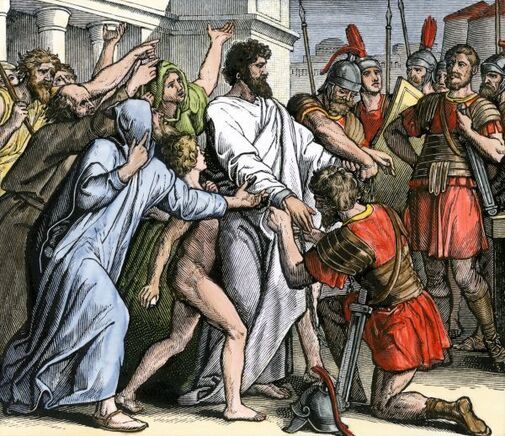
Acts 21 marks a significant turning point in the Apostle Paul’s journey—a moment not of triumph or miracles, but of surrender. And in that surrender, we encounter one of the most profound portrayals of what it means to walk willingly into the will of God, even when that path leads to suffering.
As the chapter begins, Paul is on his way to Jerusalem. He is not unaware of what awaits him. From the very beginning of this chapter, he is met with repeated warnings. The believers in Tyre “through the Spirit” urge him not to go. Later, in Caesarea, a prophet named Agabus dramatizes Paul’s future by binding his own hands and feet with Paul’s belt and declaring that the man who owns this belt will be bound and delivered over to the Gentiles.
Those around Paul are distraught. His friends—his spiritual family—plead with him not to continue. Their love for him is genuine. Their concern is real. They can’t bear to see him suffer. And yet Paul responds with these words:
“Why are you weeping and breaking my heart? I am ready not only to be bound, but also to die in Jerusalem for the name of the Lord Jesus.” (Acts 21:13)
This is not bravado. This is not recklessness. This is the voice of someone who has completely yielded his life to the will of God. Paul is not driven by a need for control, safety, or comfort. He is driven by obedience. He understands that God’s call on his life might lead him into hardship—but that calling is still worth everything.
What makes this moment so striking is how human it is. Paul doesn’t deny the pain of the situation. He doesn’t dismiss the love of his friends. In fact, he tells them plainly: “You are breaking my heart.” He feels the weight of their grief. Yet he walks forward—not out of coldness or detachment, but because he knows that love for God sometimes calls us to walk through the pain, not around it.
This passage invites deep reflection for us today. How often do we equate God’s will with ease, comfort, or favorable outcomes? How often do we assume that if something is hard, it must not be what God wants for us?
But the truth is this: obedience does not always lead to safe places. Sometimes it leads into storms, into rejection, into prisons. Sometimes it leads to a cross.
Yet in those places, we are not abandoned. We are accompanied. God does not send us into suffering without going before us. His Spirit sustains, comforts, and strengthens. The path may be difficult, but His presence remains constant.
Paul’s journey to Jerusalem, and ultimately to Rome, would not be easy. It would involve arrest, trial, hardship, and chains. But through those very chains, the gospel would be proclaimed to rulers and kings. Letters would be written from prison that would encourage and instruct the Church for centuries to come. What looked like loss became eternal gain in the hands of God.
This chapter teaches us that we must not measure the value of a path by how smooth it is, but by who has called us to walk it.
When we are faced with decisions, with trials, or with fearful futures, we can ask ourselves: Am I willing to go where God is leading, even if it costs me something? Am I willing to trust that His purpose is greater than my pain? Can I believe that even in the midst of suffering, He is working out something I cannot yet see?
Following Jesus means that we will sometimes be called to say yes when everything in us longs to say no. It means trusting that obedience is more important than understanding. It means believing, like Paul did, that our lives are not our own—that we have been bought with a price, and that our highest calling is to glorify God, even when the way is hard.
Paul’s words echo through the centuries with a quiet, powerful conviction: “I am ready.”
May we be able to say the same—not with fearlessness, but with faith. Not with certainty about the outcome, but with certainty about the One who leads us.
We may not all be called to face chains or death, but we are all called to lay down our lives—our plans, our comfort, our control—at the feet of Christ. That kind of surrender is costly. But it is also the way to true peace, and to a life that bears fruit beyond anything we can imagine.
Let us walk forward, like Paul, with hearts anchored not in the security of the path, but in the faithfulness of the God who walks beside us.
 Way & Soul
Leave a comment