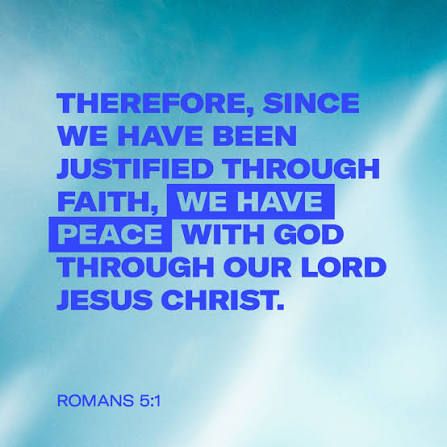
“Therefore being justified by faith, we have peace with God through our Lord Jesus Christ.” – Romans 5:1 (KJV)
Romans 5 presents one of the clearest declarations of the blessings that flow from justification by faith.
First, we are given peace with God—not merely a feeling, but a restored relationship through the blood of Jesus Christ. The war between sinful man and a holy God is ended at the cross.
Through Christ, we have access by faith into this grace wherein we stand (v.2). We do not waver in and out of God’s favor. We stand firmly in grace, secured by the finished work of our Savior.
And we rejoice in hope of the glory of God. This is not a hope that wishes—it is a hope that knows. Our future glory is assured because Christ has already made the way.
But Paul goes further: “We glory in tribulations also…” (v.3). Why? Because tribulation is not meaningless. For the believer, suffering produces patience, patience brings experience, and experience gives birth to a hope that shall not make us ashamed—because “the love of God is shed abroad in our hearts by the Holy Ghost” (v.5).
This chapter reminds us of the depth of God’s love: “While we were yet sinners, Christ died for us.” (v.8). Not when we were righteous. Not when we were seeking Him. But when we were enemies, ungodly, and helpless—He loved us, and He gave His Son.
Romans 5 teaches us that salvation is not just about being forgiven; it’s about being reconciled, secured, and kept by the love of God. If Christ died for us when we were sinners, how much more shall He keep us now that we are His?
The loss of a public figure like Charlie Kirk has stirred many emotions and reflections. It’s a moment where people from all walks of life pause to consider the fragility of life and the certainty of death. No matter our political views or how we perceive his life and work, his passing is an opportunity for us all to remember a foundational spiritual truth—our righteousness before God is not determined by our accomplishments, positions, or even our most passionate ideologies. It’s determined by faith in God’s promises.
Romans 4, especially in its focus on Abraham’s faith, reminds us that righteousness comes not from what we do, but from what we believe. Abraham was declared righteous not because he was perfect, but because he trusted God. The same is true for us. In a world where people often build their identity around accomplishments and public recognition, this is a humbling and liberating truth. It forces us to confront the reality that, ultimately, it is not our works but our faith in God’s grace that justifies us.
The Tragedy of Life’s Fragility and the Hope of Eternal Promise:
Recent events like Charlie Kirk’s passing remind us how fleeting life is. Death doesn’t care about our opinions, accomplishments, or beliefs; it is a reminder that we all face the same end. And yet, this is precisely where the message of Romans 4 offers hope. Paul’s words call us back to the foundational truth that God’s promises are unshakable, even in the face of death.
The chapter invites us to look at Abraham, who believed in God’s promise even when it seemed impossible. Abraham trusted that God could give life to the dead (Romans 4:17), even when the circumstances—his age, his wife’s barrenness—suggested otherwise. This is the kind of faith that is needed when we face loss, grief, and uncertainty. The hope we hold on to is not tied to this world or to our achievements, but to the resurrection power of Jesus Christ, who overcame death itself.
The Question of Legacy:
As we remember the life of Charlie Kirk, many will ask: What will my legacy be? In a society that often measures value by success, influence, and recognition, Romans 4 invites us to reconsider the true nature of our legacy. The legacy of faith is one that transcends the temporal. Just as Abraham was counted as righteous because of his trust in God, so too are we invited to leave a legacy of faith—a faith that points others not to our own works or ideologies, but to God’s faithfulness.
As Paul says in Romans 4:23-25, this righteousness is not just for Abraham; it’s for all who believe in the God who raised Jesus from the dead. Our legacy, at its core, is not about what we’ve accomplished, but about how we’ve trusted God with our lives, even in the face of death.
Faith in the Midst of Tragedy:
In the wake of tragedy, when everything seems uncertain, Romans 4 reminds us of the steadfastness of God’s promises. Faith isn’t the absence of grief or pain—it’s the ability to hold onto hope in the midst of it. Just as Abraham held onto God’s promise when the world around him seemed impossible, we are called to trust in the greater reality of God’s promise of eternal life through Jesus.
In times like these, as we reflect on the passing of a public figure or someone close to us, we are reminded that true peace comes from knowing that we are justified by faith, not by works. As Romans 4 teaches us, “faith is counted as righteousness” (Romans 4:5). Our faith in Jesus Christ is what holds us firm in the face of life’s most difficult moments.
Reflection: The death of Charlie Kirk, and any loss, brings us face to face with the deepest questions of faith. In moments like this, we are reminded that our hope is not in our achievements or our opinions, but in the promises of God. Are we, like Abraham, able to trust God’s promises even in the darkest moments? Can we hold on to the truth that our righteousness is secured not by our works, but by our faith in Christ?
Let us remember that we are justified by faith, that we are heirs of God’s eternal promises, and that our true hope lies in the resurrection power of Jesus Christ.
Prayer: Father, as we reflect on the life and death of Charlie Kirk and all those we’ve lost, we are reminded of the fragility of life. But we also remember that our hope is in You, and that our righteousness is not based on our works but on our faith in Your promises. Help us to trust You more deeply, especially in times of loss. May our legacy be one of unwavering faith, and may we rest in the hope of the resurrection. In Jesus’ name, Amen.
 Way & Soul