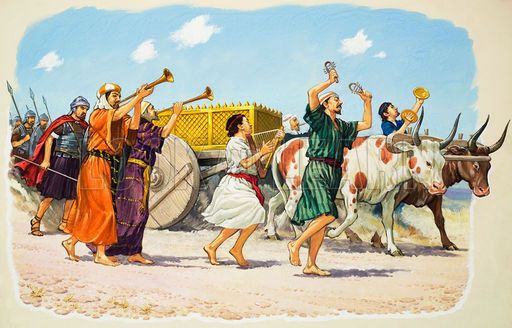
There’s a passage in 2 Samuel 6 that many of us quietly wrestle with. It’s the moment when King David, full of passion and zeal, sets out to bring the Ark of the Covenant back to Jerusalem. The mood is joyful, the music is loud, and the celebration is grand. This feels like worship—it looks like worship—but then something unexpected, even unsettling, happens.
As the oxen pulling the cart stumble, Uzzah reaches out his hand to steady the Ark, and God strikes him dead on the spot.
It’s a jarring moment. A moment that, on the surface, feels unfair. Wasn’t Uzzah just trying to help? Wasn’t he doing the right thing? But as we sit with this story and listen with the ears of the Spirit, we realize the lesson isn’t about punishment—it’s about perspective.
God doesn’t need us to hold Him up.
The moment Uzzah reached out, perhaps with the best of human intentions, he forgot that the God who created the heavens and the earth is not a deity who teeters and falls. He doesn’t need to be caught. He doesn’t need to be protected. The Ark wasn’t just a box—it was the representation of God’s holy presence among His people. And God had already given clear instructions for how it was to be carried—on the shoulders of the Levites, not on a cart, and certainly not touched.
It wasn’t a matter of Uzzah’s sincerity. It was a matter of God’s holiness.
This passage confronts us with a difficult but necessary truth: Sometimes our good intentions still fall short of God’s instructions.
In our own lives, how often do we try to “steady” God? How often do we rush to protect His name, His church, His reputation—as though He might collapse without our efforts? We plan, we strategize, we innovate, we build platforms and programs—all to “carry” God in ways that make sense to us. But the question that echoes from 2 Samuel 6 is not whether we are passionate about God, but whether we are being obedient to Him.
This passage also teaches us that worship is not about what feels right to us—it’s about what’s right in His eyes.
David’s first attempt to bring the Ark was filled with energy and excitement, but not with obedience. The method didn’t match the mandate. It wasn’t until David paused, reflected, and returned to the Word of the Lord that he realized something crucial: God is not moved by noise, emotion, or effort alone—He is moved by hearts that honor His holiness.
And when David brought the Ark back the second time—carried the right way, with sacrifice and reverence—then the celebration took on its full meaning. There was joy again, but now it was joy rooted in obedience.
We live in a time when worship is often shaped by personal preference, emotion, and experience. But the message of this chapter reminds us: Worship is not ours to define. It is God’s to direct. We cannot reduce worship to a feeling or a formula. True worship begins when we approach God on His terms, not our own.
There’s nothing wrong with creativity, beauty, or even emotion in worship. But without reverence, those things become noise. Without obedience, our worship becomes self-expression rather than God-exaltation.
So maybe the deeper invitation of 2 Samuel 6 is to ask ourselves some searching questions:
Have we made worship about what moves us, rather than what pleases Him?
Have we tried to steady what God never asked us to carry in our way?
Have we forgotten that the God we approach is still holy, still consuming, still utterly unlike us?
And have we remembered that the safest, truest place of worship is always the one that starts in surrender?
God doesn’t need our hands to hold Him up. He asks for our hearts to be bowed down.
May we learn to worship not just with passion, but with awe.
Not just with celebration, but with submission.
Not just with hands lifted high, but with lives laid low.
Because only then do we truly see Him for who He is: Holy, Sovereign, and Worthy of it all.
 Way & Soul
Leave a comment