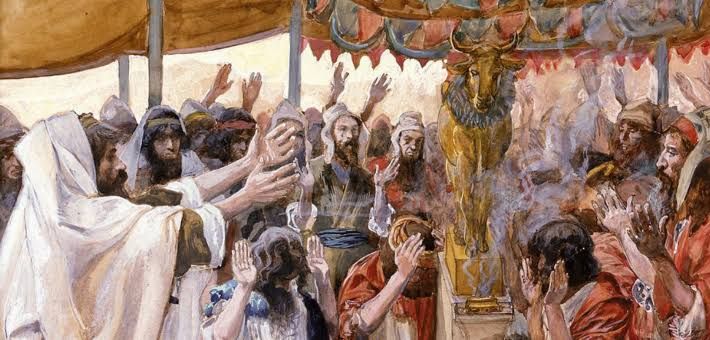
Exodus chapter 32 stands as one of the most sobering and instructive passages in all of Scripture. It reveals the tragic frailty of the human heart and the peril of turning aside from the living God, even in the very shadow of His glory. Israel, newly delivered from bondage and standing at the foot of Mount Sinai, falls swiftly into idolatry while Moses communes with God on the mountain. The people, impatient for his return, demand a tangible object of worship. Aaron, yielding to their clamor, fashions a golden calf, proclaiming, “These be thy gods, O Israel, which brought thee up out of the land of Egypt.”
I. The Roots of Idolatry: Impatience and Forgetfulness
The sin of the golden calf was not merely the making of an image, but the manifestation of a deeper spiritual disease: impatience with God’s timing and forgetfulness of His covenant. Israel had witnessed the might of the Lord in their deliverance; yet, in the space of a few days, their faith faltered. When divine providence seemed delayed, they sought visible assurance.
So it is with the human soul. When the presence of God seems hidden, when prayers appear unanswered, and when heaven is silent, we are tempted to grasp after substitutes — to seek comfort in what is seen rather than trust in what is unseen. The golden calf is thus not only Israel’s folly but a symbol of all human attempts to replace faith with sight.
II. The Wrath of God and the Mediation of Moses
The narrative then turns to God’s righteous anger. The Lord declares His intent to consume the people for their transgression, offering to make of Moses a new nation. Yet Moses, the faithful servant of God, intercedes on behalf of Israel. He pleads not on the basis of their merit, but upon the honor of God’s name and His covenant promises to Abraham, Isaac, and Jacob.
This act of intercession foreshadows the work of our Lord Jesus Christ — the greater Mediator, who stands before the Father on behalf of sinners. Just as Moses interceded for a rebellious nation, so Christ intercedes for His church, pleading not our righteousness but His own. Through His mercy, divine wrath is tempered, and grace prevails over judgment.
III. The Breaking of the Tablets: Judgment and Renewal
When Moses descends and beholds the idolatry of the people, he casts down the tablets of the Law, breaking them at the foot of the mountain. This act is not mere anger but a profound symbol: the covenant has been broken by the sin of the people. Before renewal can occur, the old must be shattered. Later, new tablets are given — a sign of divine forgiveness and the restoration of relationship.
Likewise, in the spiritual life, there are moments when God permits the breaking of what is outwardly good, so that a deeper and truer covenant might be written upon our hearts. As the prophet Jeremiah would later declare, “I will put my law in their inward parts, and write it in their hearts” (Jeremiah 31:33). Thus, the breaking becomes the means of renewal.
IV. The Call to Faithful Worship
Exodus 32 is not merely a historical account; it is a warning to every generation. God demands worship that is pure, spiritual, and rooted in truth. The golden calf may have been melted and ground to dust, but idols still arise wherever the human heart seeks satisfaction apart from God. Whether our idols are fashioned from gold, ambition, pleasure, or pride, they remain affronts to the holiness of the Lord.
Therefore, the call of this passage is to steadfastness — to wait upon God even in the silence, to trust His timing, and to guard the purity of our worship. True faith clings to the unseen presence of God and rests upon His Word alone.
A Closing Prayer
Almighty and Everlasting God,
who didst show mercy to Thy people when they turned aside to idols,
grant unto us, we pray Thee, steadfast hearts,
that we may not grow weary in waiting upon Thee,
nor seek after false comforts in times of delay.
Write Thy law anew upon our hearts,
and by Thy Holy Spirit keep us faithful to Thy covenant,
through Jesus Christ our Lord. Amen.
 Way & Soul
Leave a comment